
Canada is failing to lead on Arctic shipping’s black-carbon pollution
As an Arctic country with heavy shipping interests, Indigenous reconciliation a priority, and with climate leadership ambitions, Canada’s voice matters a great deal on this issue.
Op-Ed | BY AARON FREEMAN, ANDREW DUMBRILLE
Republished with permission by The Hill Times on April 16, 2026
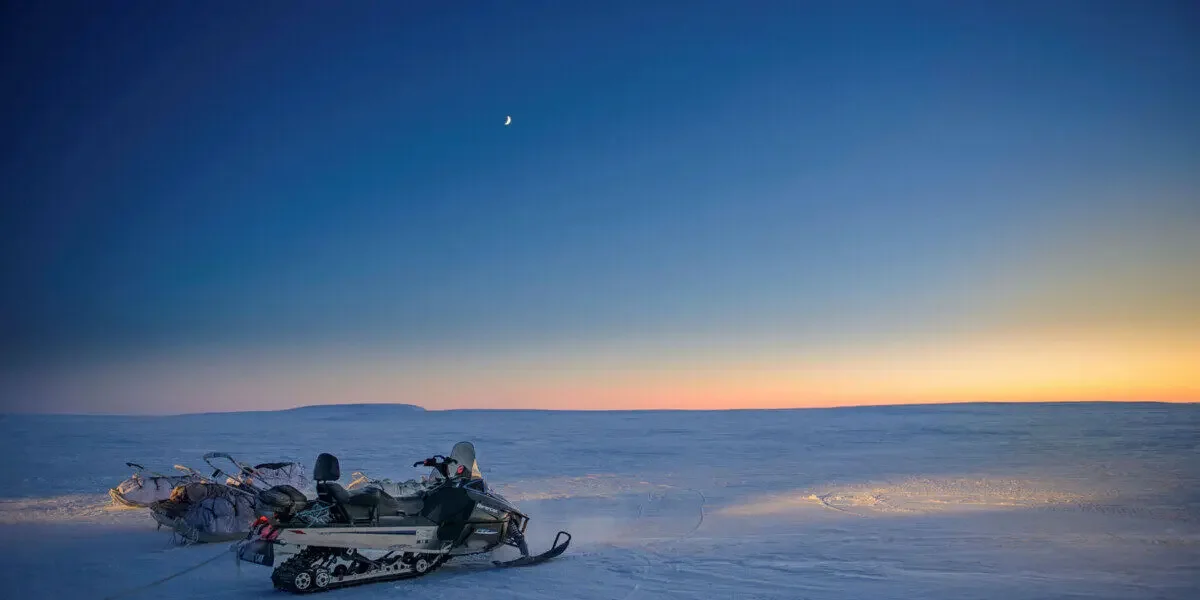
Snowmobiles light the drop zone before the 3rd Battalion Princess Patricia's Canadian Light Infantry parachute drop during Exercise Arctic RAM near Resolute Bay, Nunavut, on Feb. 12, 2016. Photograph courtesy of MCpl. Louis Brunet, Canadian Army Public Affairs
The Canadian Arctic has captured a great deal of recent attention. Climate change has reduced sea ice levels, making mining, oil and gas development more accessible and increasing shipping traffic and global security concerns. The resulting economic and defence implications have attracted the interest of Canadian and global leaders, and are at the heart of U.S. President Donald Trump’s threats to annex Greenland.
In Canada’s north, a substance called black carbon is one of the most potent pollutants that are driving these changes, both locally and globally. Black carbon is up to 1600 times more potent than CO2 as a climate pollutant. Together with methane and ozone, it is responsible for nearly half of all global warming to date. Its warming potential is even higher in the Arctic, where deposition on ice and snow accelerates melt, which then exposes darker surfaces that absorb more heat.
Black carbon emissions are at the intersection of climate, pollution, biodiversity and communities in the Arctic. By reducing emissions, negative health outcomes such as respiratory and heart diseases are addressed, food security is strengthened by slowing sea ice loss and maintaining Indigenous harvest areas and routes, and local climate warming is slowed. Prioritizing issues and solutions with these types of co-benefits is essential in these times of accelerating planetary crises.
Especially in the Arctic, shipping is an important source of black carbon. In 2011, the International Maritime Organization (IMO), which regulates international shipping, was tasked with limiting the impact of black carbon. After 15 years of delay, Canada’s close Arctic ally Denmark, along with Germany, France and many others, have finally put forward a proposal to require ships in the Arctic to use cleaner fuels that are available on the market. The proposal is fuel-agnostic, so ship operators would be free to choose from among several clean fuels on the market, so long as the needed emission reductions are achieved. However, methane must not be considered an acceptable alternative. Like black carbon, it is a potent climate forcer, and replacing one superpollutant with another would undermine the very purpose of the proposal.
Unfortunately, Canada is not among those advocating for change, sitting on the sidelines as the usual suspects – Russia, China, UAE and the United States – oppose the proposal.
This is puzzling, as Canada’s Arctic is warming four times faster than the rest of the world, the Inuit Nunangat Policy on self determination needs full implementation, and it has long been a priority for Canada to to reduce black carbon across the economy. Between 2013 and 2024, Canada decreased its multi-sector black carbon emissions by 40 percent. And, Canada was front and centre at last year’s UN Climate negotiations, launching a major new initiative and commitment to lead on black carbon reductions. The next logical step would be to support the Danish proposal to establish the first marine shipping regulation to specifically target black carbon.
To address any added costs to consumers, the federal government would need to assist financially strained northern communities to ensure they are not bearing the economic burden of a pollution problem that has largely been created by other parts of the world. Commitments have already been made in this regard by Transport Canada to manage this transition for other measures that Canada has administered, including the Arctic Heavy Fuel Oil ban and Arctic Emission Control Area.
The good news is that it’s not too late for Canada to get off the sidelines and support the use of cleaner fuels in our ecologically sensitive Arctic region. This fall, the IMO will meet again to discuss the proposal and Canada can align with our allies and call for concrete regulation of this superpollutant.
As an Arctic country with heavy shipping interests, Indigenous reconciliation a priority, and with climate leadership ambitions, Canada’s voice matters a great deal on this issue.
Aaron Freeman is Managing Partner and Founder of Pivot Strategic, an independent government relations firm.
Andrew Dumbrille is advisor to the Clean Arctic Alliance and co-founder of Equal Routes, a non-profit centering communities and rights holders to create a sustainable and equitable marine shipping sector.
