
Canada commits public money to LNG infrastructure as Asian demand turns
Before more public money flows into LNG export terminals, LNG-fuelled vessels, or the bunkering infrastructure linking them, the committee, the federal institutions extending credit and guarantees, and the council itself should account for who, in the actual buying countries, will still be there to take the gas a decade from now.
Opinion | BY SEOYOON KIM, ANDREW DUMBRILLE, ELISSAMA MENEZES
Originally published by The Hill Times, Monday July 20, 2026
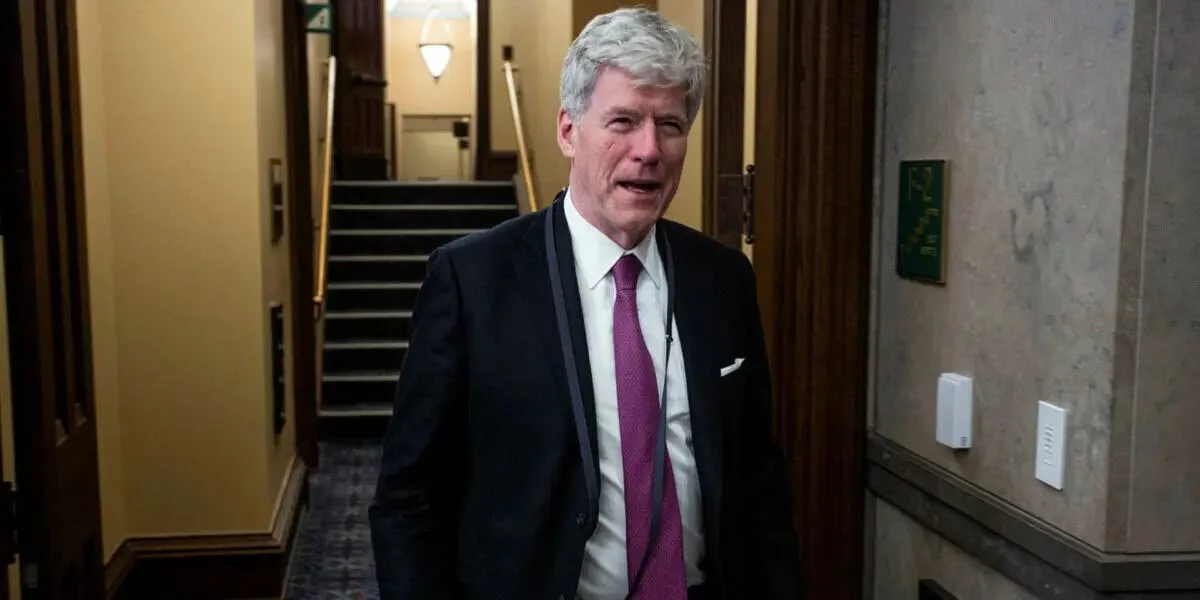
Federal Energy and Natural Resources Minister Tim Hodgson, pictured Feb. 10, 2026. The Hill Times photograph by Andrew Meade
When the first LNG tanker departed Kitimat for Asia on June 30, 2025, it carried the assumption that has shaped a decade of Canadian public investment: that Asian buyers would be waiting at the other end, ready to absorb the output of new export terminals, pipelines, and the fleet of LNG-fuelled vessels and bunkering hubs being built to serve them. Less than a year on, that assumption is breaking down on both sides of the Pacific.
On the Canadian side, the project's own commercial partners are quietly repositioning. Petronas sold part of its LNG Canada exposure to MidOcean Energy last December. Mitsubishi has retained RBC Capital Markets to weigh its options. Reuters reported in January that Shell, which holds a 40 per cent stake in LNG Canada, has hired Rothschild & Co to find buyers for as much as three-quarters of its holding, distinguishing between Phase 1's operational LNG demand and Phase 2's longer-term demand risk.
None of these moves alone tells the story. Together, they describe an investor class that is reading the buyer-side picture more carefully than Canadian policy currently allows for.
That picture, from Asia, is straightforward. The market that justified Canadian LNG investment is structurally contracting. South Korea — the world's third-largest LNG buyer and one of the markets most often cited in Canadian export pitches — projected in its 15th Long-Term Plan for Natural Gas Supply and Demand, drafted before the US-Israeli war on Iran began, that domestic gas demand would fall 16.5 per cent by 2036. Since the war, Seoul has fast-tracked renewables deployment toward a 100-gigawatt 2030 target as part of a wider effort to minimize LNG imports. Korea's Minister of Climate, Energy and Environment told CNBC in April that the war is serving as a "significant turning point" in the country's transition toward renewable energy.
The same reorientation is underway across the region. Vietnam's largest private conglomerate walked away in April from a 4.8-gigawatt Hai Phong LNG-to-power facility on which it had broken ground only seven months earlier, citing unaffordable fuel costs. China cancelled a planned LNG terminal expansion, and Chinese imports in early 2026 are at their lowest level since 2018. Pakistan, once forecast as a major LNG growth market, has avoided more than US$12 billion in oil and gas imports between 2021 and February 2026 by building out distributed solar instead. The Philippines, Thailand, and Cambodia have each announced measures to accelerate renewables and ramp down LNG.
Some Asian buyers are responding to the crisis with the same playbook as 2022: more long-term contracts, more diversification, more LNG tanker orders. But the directional evidence is unmistakable. This is not a temporary supply-shock response that will reverse when shipping through the Strait of Hormuz fully resumes. It is a structural reallocation of capital and policy toward energy systems that do not depend on imported LNG. Even gas industry executives are saying so on the record: a Shell representative in March warned that geopolitical shocks of this kind are sending the wrong signals to gas customers about the long-term fundamentals of the fuel.
Canadian taxpayer money, however, is still flowing in the opposite direction — and not only into the terminals at the loading end. It is funding the entire maritime supply chain: the export facilities at Kitimat, the LNG-fuelled tankers and bunkering hubs being built to move Canadian gas across the Pacific, and the public-credit guarantees underwriting both.
The federal and British Columbia governments have committed at least CAD $3.93 billion in public support for LNG terminals and pipelines through 2030. That estimate does not include federal export credit, LNG Canada Phase 2, or Canadian exposure to the LNG shipping side of the supply chain — which is where the maritime story sits.
Globally, public finance institutions have directed more than US$21.9 billion to maritime LNG projects between 2013 and 2025. More than half of that — over US$12 billion — financed LNG-fuelled vessels and bunkering being deployed alongside terminals whose buyer base is contracting. And more than US$8 billion of the total was labelled "green" under ambiguous frameworks. Canada is now deciding whether to repeat that pattern: the new federal Taxonomy and Transition Planning Council, appointed in April, will set the criteria by the end of 2026 that determine whether maritime LNG infrastructure can be labelled "green" or "transition" investment under Canadian rules.
This spring, the House of Commons Standing Committee on Natural Resources is also finalizing its study on Canadian energy exports. Before more public money flows into LNG export terminals, LNG-fuelled vessels, or the bunkering infrastructure linking them, the Committee, the federal institutions extending credit and guarantees, and the Council itself should account for who, in the actual buying countries, will still be there to take the gas a decade from now. The project's own partners are already running that calculation. Canadian taxpayers should know what answer they're arriving at.
Seoyoon Kim is head of Korea gas policy at Solutions For Our Climate. Andrew Dumbrille is co-director of Equal Routes, and Elissama Menezes is co-director Equal Routes. Solutions For Our Climate and Equal Routes are members of Maritime Beyond Methane (MARBEM).
