By Aaron Freeman, Andrew Dumbrille| Originally published in The Hill Times | October 29, 2026
In the context of Canada’s new foreign policy direction and its desire to play a leadership role amongst middle powers, joining with these countries to control dangerous black carbon emissions should be an obvious choice. Canada should join with its allies and support the polar fuels proposal at the IMO.
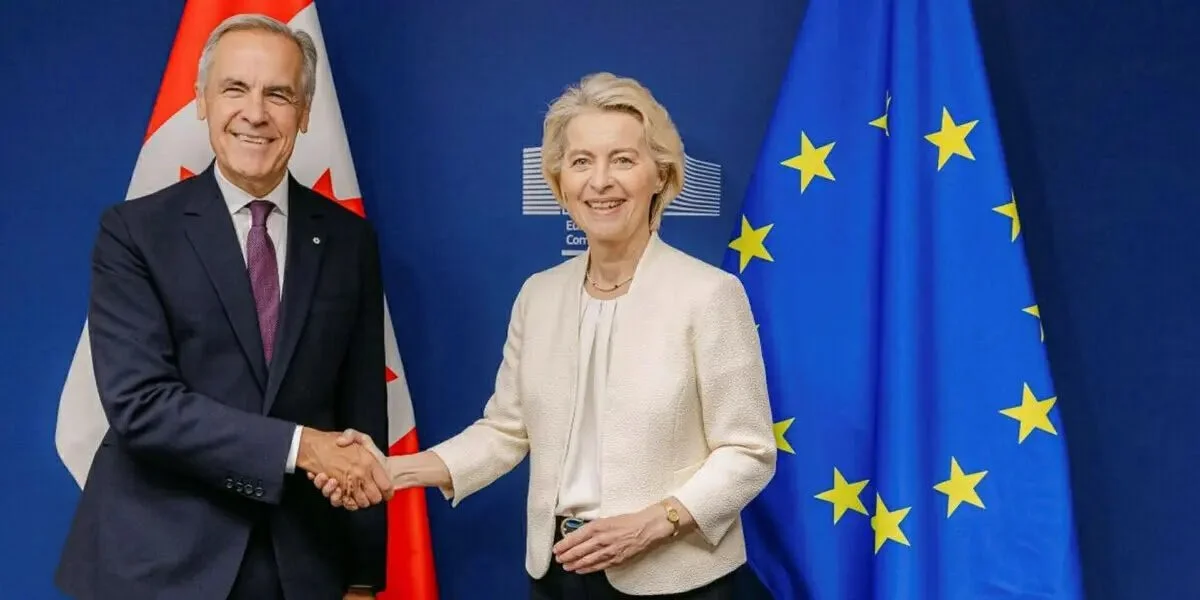
Prime Minister Mark Carney, left, and Ursula von der Leyen, president of the European Commission met in Strasbourg, France, after Carney attended her State of the European Union address on Sept. 16, 2026.European Union photograph 202X, licensed under CC BY 4.0
Prime Minister Mark Carney’s Build Canada Strong approach responds to U.S. trade threats by diversifying our trade and diplomatic relationships beyond the United States. In particular, the prime minister has highlighted the need for linkages with middle powers, especially Europe, so that these countries are not squeezed out by global powers that are increasingly seeking to consolidate their influence.
“Some outside our borders are working to break us so they can own us,” Carney said shortly before the Alberta independence vote.
Carney is aggressively pursuing trade deals with various countries, and is meeting this week with European Commission President Ursula Von der Leyen in Montreal to discuss an “Alliance for the Future” that could involve Canada becoming an associate member of the EU.
Regardless of how Canada and Europe decide to name their new relationship, forming closer ties with middle powers must involve taking action on common challenges that lie before them. The EU recognized this when Von der Leyen included Arctic co-operation as a “priority for further collaboration” with Canada within the associate membership discussions.
One of the most immediate challenges for northern countries is dealing with the causes and effects of the climate crisis. One pollutant in particular, black carbon, is a short-lived climate forcer with particular impacts affecting northern communities. Europe wants to take action on this superpollutant and has asked for Canada to join them, but to date, Canada has been sitting on the sidelines.
On Oct. 20, von der Leyen announced the launch of the EU Arctic Strategy, stating “at the international level, the EU will contribute actively to negotiations at the International Maritime Organisation [IMO] to facilitate the transition of Black Carbon measures from voluntary guidelines to binding regulations.”
Black carbon, commonly known as soot, is emitted from the burning of marine fuels. In Arctic shipping, heavy fuel oil (HFO) is a significant source of these emissions. The North is not only disproportionately affected by the climate crisis, but black carbon has a local warming effect when it settles on icy land and seascapes and absorbs more solar heat, accelerating the melting of sea ice and permafrost.
Nearly a year ago, European and other countries, led by Denmark, proposed to replace HFO in Arctic shipping with cleaner alternatives to reduce black carbon. The proposal has been steadily gaining support from other countries as it seeks approval at an upcoming IMO meeting. Canada has remained uncommitted but has an opportunity to sign on to the initiative by Nov. 20.
Inuit organizations recognize the importance of regulating black carbon, and are supportive provided that any costs to northern communities are covered by the federal government. Research suggests that such costs are expected to be manageable, and that the costs of inaction, which can lead to toxic fuel spills, is likely to be significantly more expensive.
By adopting the polar fuels regulation, the IMO would dramatically reduce emissions of black carbon from ships sailing in the Arctic, which will have a near instantaneous and quickly measurable positive impact on the regional and global climate.
In the context of Canada’s new foreign policy direction and its desire to play a leadership role amongst middle powers, joining with these countries to control dangerous black carbon emissions should be an obvious choice. Canada should join with its allies and support the polar fuels proposal at the IMO.
Aaron Freeman is managing partner and founder of Pivot Strategic, an independent government relations firm. Andrew Dumbrille is adviser to the Clean Arctic Alliance and Co-director of Equal Routes, a non-profit centering communities and rights holders to create a sustainable and equitable marine shipping sector.
