Press Release: New shipping report underscores inevitability of underwater noise regulations, aligned with IMO climate and biodiversity targets
Report urges action and offers equitable reduction pathways
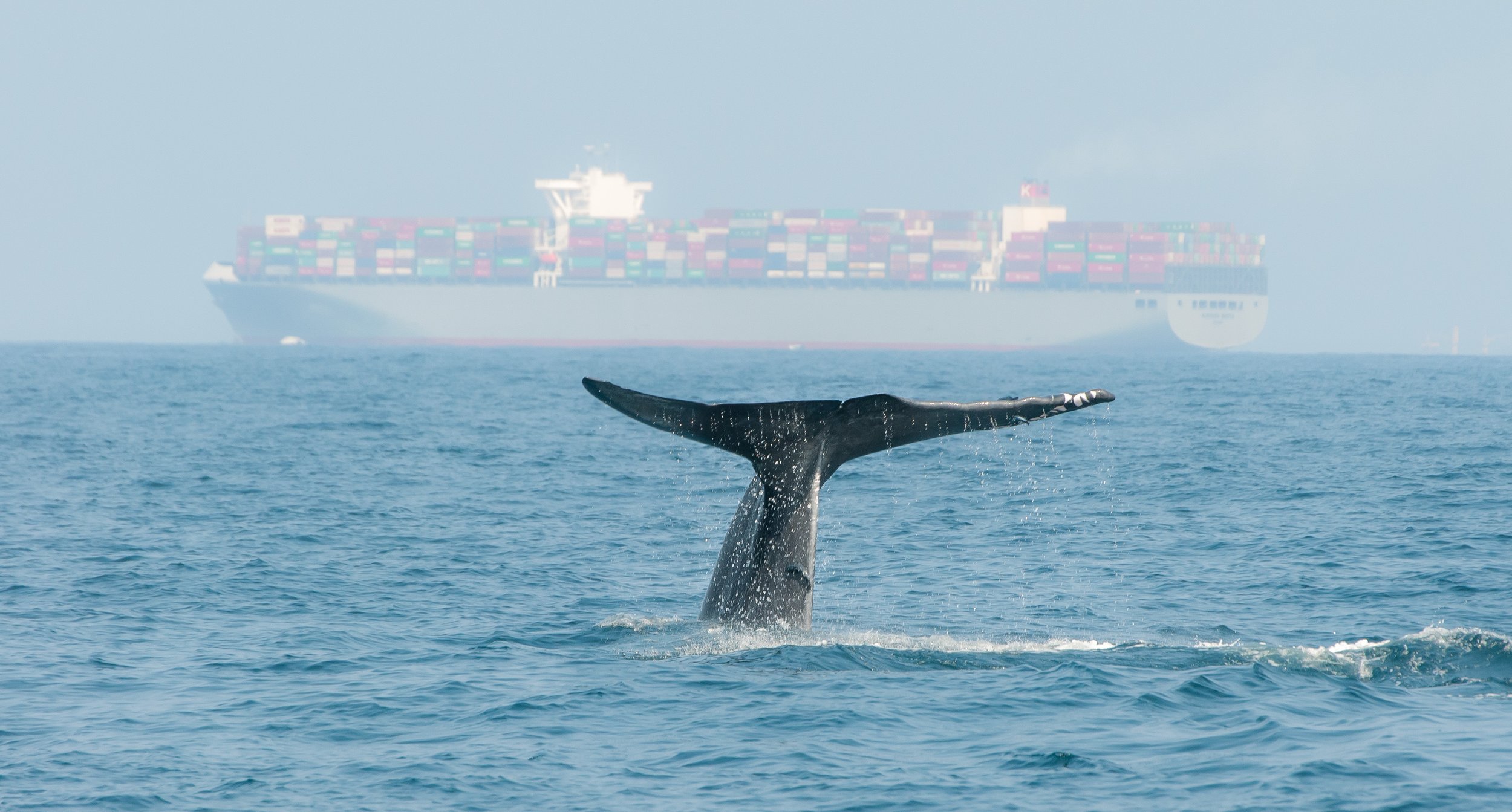
Photo: Blue whale diving near Sri Lanka
February 19, 2026 | Underwater noise levels are rising—particularly in the Arctic Ocean—yet the shipping sector’s contributions remain under-prioritized by the International Maritime Organization (IMO), the global regulator for international shipping. Ahead of the IMO’s 2026-2027 review of energy efficiency measures and reduction targets, Equal Routes urges action with a new report, Charting the Course to a Quiet Ocean.
The report finds that effective noise reduction requires a whole-system approach with responsibility shared across regulators, ports, shipowners, classification societies, and Indigenous communities whose rights and knowledge are essential to governance. It outlines actionable pathways for a long-term strategy that reduces underwater noise while advancing decarbonization, energy efficiency, and biodiversity goals.
Drawing on interviews and surveys with 17 shipping experts across 13 countries, stakeholders identified regional speed reductions in ecologically sensitive areas, vessel retrofits, expanding wind-assisted technologies, and integrating underwater noise into the IMO's Carbon Intensity Indicator review—measures that simultaneously reduce fuel costs and greenhouse gas emissions.
“The window to integrate underwater noise into the IMO's regulatory architecture is now, as it relates to and combines with the Carbon Intensity Indicator to increase decarbonization and energy efficiency,” says Elissama Menezes, co-director at Equal Routes. “Underwater noise pollution harms marine life, ecosystems, and the communities that depend on them — it deserves far greater attention in shipping policies and regulation. We can change that with an integrated approach that centres Indigenous rights and knowledge, and builds toward binding regulation grounded in a just and equitable transition. We must work collaboratively to establish targets and policies that achieve meaningful reductions by 2030 and beyond.”
Previous research shows that underwater radiated noise could double every decade, with Arctic median levels quadrupling between 2019 and 2030. Yet there are no binding international regulations, and voluntary uptake remains limited. The IMO Action Plan and Experience-Building Phase (EBP) is building the evidence base for mandatory measures that could deliver significant co-benefits when aligned with decarbonization, energy efficiency, and biofouling policies.
“Several stakeholders in our study are encouraged by this year’s enactment of the UN’s Biodiversity Beyond National Jurisdiction, and they believe that mandatory regulations for underwater radiated noise are eventually likely to come into effect,” says Breanna Bishop, research lead at Equal Routes. “Reduction is feasible—and without significant financial and logistical burdens—particularly when we intentionally combine this with measures to increase decarbonization and energy efficiency, and reduce biofouling. The best pathway is to continue to elevate this issue and include data and realities from the Global South, the Arctic, Indigenous and Inuit communities, similar to those developed by the Inuit Circumpolar Council for the IMO three years ago.”
Equal Routes will bring these findings to the upcoming IMO Marine Environment Protection Committee (MEPC) meeting in April, urging Member States to establish binding targets, strengthen measurement and baselining standards, and center the voices of communities most affected.
Stakeholders emphasize that solutions must extend beyond technology to include equity-focused policies that deliver benefits to frontline communities:
John Taukäve, Oceania cultural protocol, technical advisor and researcher to Pacific delegations at the IMO.
“For our Oceania communities, our relationship with sound has held strong ancestral connections acknowledging an understanding of our place within our Moana or Oceans. A Just and Equitable approach to limiting underwater radiated noise ensures our voices, our livelihoods as well as our Moana and everything that resides in her domain are protected.”
Jase Hatcher, Senior Campaigner for Climate and Oceans at Friends of the Earth U.S.
“The shipping sector's contribution to human-caused underwater radiated noise is well-established. While many nations have pledged to reduce this pollution, we must act with immediate urgency, ensuring these measures are part of a just and equitable transition. No industry or nation’s bottom line takes precedence over the protection of our ocean, all that call it home, and all who have stewarded these relationships for time immemorial. Today’s report is a vital addition to the growing literature on URN from ships, reinforcing the need for a just transition in all URN reduction strategies.”
– 30 –
Media Resources
Charting the Course to a Quiet Ocean: IMO Stakeholder Perspectives and Case Studies on Reducing Underwater Radiated Noise draws on interviews and surveys with international shipping stakeholders and is accompanied by case studies from Inuit Nunaat and the Arctic—where the Inuit Circumpolar Council has led the development of underwater noise guidelines that centre Indigenous knowledge—and the South Pacific, where Pacific Islander communities are at the IMO advocating for a just and equitable shipping transition that centres cultural relationships with the ocean.
About Equal Routes
We prioritize the needs and perspectives of communities and rights holders, working in collaboration with regulators and industry leaders to drive positive change in the shipping sector. Equal Routes is a member of the Clean Shipping Coalition, the Clean Arctic Alliance, Maritime Beyond Methane, and we are an accredited organization at the UN Ocean Conference, www.equalroutes.ca
For more information or to request an interview, please contact:
Rachel Jai-Sho Wang | rachel@equalroutes.ca
